
Manuka honey: what it is, what UMF™ and MGO mean, and how to choose
Manuka honey is one of the most prized honeys in the world — and one of the easiest to spot on the shelf by price alone: from €40 to well over €150 a jar. This guide explains where it comes from, what the numbers on the label mean and how to choose the right jar — without the marketing noise.
What is manuka honey?
Manuka honey is a monofloral honey that bees make from the flowers of the manuka bush (Leptospermum scoparium). The bush grows wild in New Zealand and flowers for only a few weeks a year. A short flowering season, remote locations and strict controls mean that little manuka honey is produced — which is why it is expensive.
The taste is darker and more intense than everyday honey: caramel-like, slightly herbal, with a long finish. The texture is thick, creamy, almost chewy.
Why is manuka honey so expensive?
- Small harvests. Manuka flowers for just 2–6 weeks a year, often on hillsides and in the bush, where hives have to be flown in by helicopter.
- New Zealand only. Under the New Zealand government standard, genuine manuka honey comes only from there.
- Laboratory testing. Every certified batch is tested independently — it costs money, but it guarantees that you get what the label says.
Where it comes from: wild, uncultivated land
The manuka bush grows wild in New Zealand — on hillsides, at the edges of the bush and in remote areas where there are no cultivated fields and no farming. Many of these places cannot be reached by road, so beekeepers often fly their hives in by helicopter — and only for the few weeks while the manuka is in flower.
Authenticity is confirmed by a laboratory, not by the label
In New Zealand, manuka honey is defined by a government standard (MPI). For honey to be exported as manuka, it is tested in a laboratory for four natural chemical markers and for manuka pollen DNA. One of these markers — leptosperin — is found only in manuka nectar, so it works as the honey’s “fingerprint”.
UMF™ certification goes further: every Haddrell’s batch is independently tested for potency (MGO), authenticity (leptosperin) and freshness. That is why the UMF™ mark and licence No. 1027 on the jar stand for a verified fact, not a promise.
What is UMF™?
UMF™ (Unique Manuka Factor) is an independent New Zealand certification system run by the UMF™ Honey Association. The UMF™ mark on a jar means the batch has been tested against four criteria:
- Potency — the MGO level;
- Purity — whether it really is monofloral manuka honey;
- Authenticity — origin and the natural markers typical of manuka;
- Freshness — whether the honey has been heated or stored for too long.
Every UMF™ licensed producer has a licence number that must appear on the label. Haddrell’s of Cambridge holds licence No. 1027. You can check it at umf.org.nz.
Read more: What is UMF?
What is MGO and how is it different from UMF™?
MGO (methylglyoxal) is a naturally occurring compound whose level indicates the strength of manuka honey. The number on the label shows MGO in milligrams per kilogram.
The key difference: MGO is a single number, while UMF™ is a complete certification system that checks purity, authenticity and freshness as well as MGO. A jar labelled only “MGO”, without the UMF™ mark, has not necessarily been tested against all the criteria.
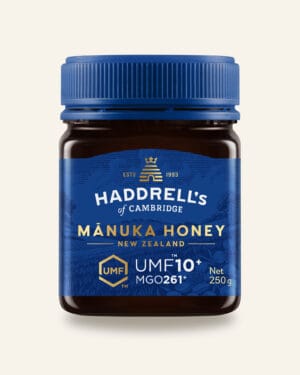
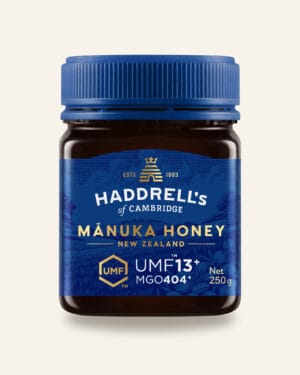
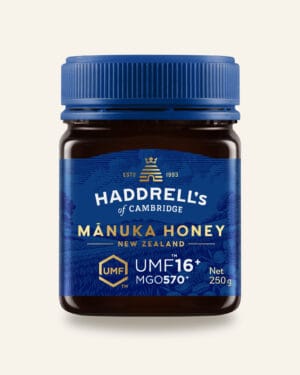
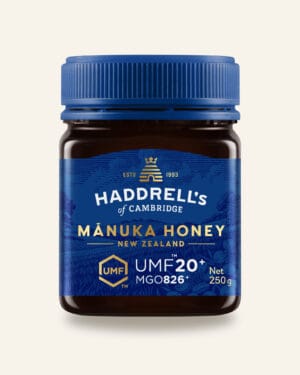
| UMF™ | MGO (on the Haddrell’s label) | Taste |
|---|---|---|
| 10+ | 261+ | mild, everyday |
| 13+ | 404+ | more pronounced |
| 16+ | 570+ | rich, caramel |
| 20+ | 826+ | the most intense, exceptional |
Read more: What is MGO?
How to recognise genuine manuka honey
Check the label — genuine certified manuka honey carries:
- The UMF™ mark and grade (e.g. UMF™ 16+);
- The UMF™ licence number (Haddrell’s — No. 1027);
- New Zealand as the country of origin, packed there;
- A specific MGO number — not “active” or “premium” without figures.
Be careful with “manuka blend” or “manuka multifloral” without the UMF™ mark, or with an unusually low price — these are often blended honeys.
How to choose the strength
The choice comes down to taste and occasion:
- UMF™ 10+ — for enjoying manuka honey every day: in tea, with yoghurt, at breakfast. The mildest taste and the most accessible price.
- UMF™ 13+ — the first step towards a bolder taste.
- UMF™ 16+ — rich and caramel-like; the most popular choice as a gift.
- UMF™ 20+ — the most intense and the rarest; for a special occasion, or as a gift for someone who appreciates the very best.
Read more: How to choose?
How to enjoy manuka honey
- In tea — stir it in once the tea has cooled to about 40 °C, so the taste and texture stay as they are.
- At breakfast — with yoghurt, granola or on toast.
- With cheese — especially aged or blue cheeses.
- Straight from the spoon — the best way to taste the difference between strengths.
Storage: at room temperature, tightly closed, away from direct sunlight. No need for the fridge. The honey may thicken a little — that is natural.
Important: honey is not suitable for children under 1 year of age.
About Haddrell’s of Cambridge
Haddrell’s of Cambridge was founded by Richard and Moira Haddrell in 1993 in Cambridge (Waikato region, New Zealand), starting with fifteen hives. The family took part in shaping manuka honey quality standards and the UMF™ Honey Association. Today Haddrell’s produces only UMF™ certified manuka honey — every batch with an independent certificate.
Manuka Medus is the official Haddrell’s of Cambridge representative in the Baltic states. We ship from our warehouse in Lithuania within 1–2 working days, to LP Express parcel lockers in Lithuania, Latvia and Estonia, with free delivery from €59.
Choose manuka honey by strength →
FAQ
Are manuka honey and UMF™ manuka honey the same thing?
Not always. The UMF™ mark means the batch has been independently tested for potency, purity, authenticity and freshness. Without the mark, there is no such guarantee.
Why does Haddrell’s UMF™ 13+ say MGO 404+ rather than 400+?
The MGO figure on the label reflects the certification of that specific Haddrell’s batch; UMF™ 13+ corresponds to at least 400 mg/kg MGO.
Does manuka honey crystallise?
It can thicken, especially in a cooler room. This is natural and does not affect quality.
How long can I keep an opened jar?
Until the date on the label, kept tightly closed at room temperature.
Where do you ship from?
From our warehouse in Lithuania, within 1–2 working days. LP Express parcel lockers in LT, LV and EE.
How is it verified that the honey really is manuka?
In a laboratory: under the New Zealand standard, 4 chemical markers and manuka pollen DNA are tested. UMF™ certification additionally confirms MGO, leptosperin and freshness for every batch.
What is leptosperin?
A natural compound found only in manuka nectar. Laboratories use it to tell genuine manuka honey apart from other honey or blends.
Why are hives flown in by helicopter?
Manuka grows in remote, uncultivated areas, often with no roads. It flowers for only a few weeks, so the hives have to be moved quickly to where the manuka is in flower.